Welcome to our comprehensive guide on gutter guard statistics, filled with verified gutter guards data for homeowners, contractors, and industry researchers.
Whether you want to understand gutter guard growth trends, compare pricing before you buy, or fine tune your exterior service strategy, this article delivers valuable data and actionable takeaways.
Read on to explore the latest gutter guard insights on market size, materials, adoption, maintenance savings, and consumer behavior shaping the gutter protection trends in 2026 and beyond.
1. Gutter Guard Market Size and Growth Trends
The gutter guard industry is expanding steadily, pushed by aging housing stock, heavier rainfall patterns, and homeowner demand for low maintenance exterior solutions.
What was once a niche accessory now sits at the center of the water management conversation for residential and commercial properties alike.
Analyst estimates vary in scope and methodology, yet every major research house agrees on the direction: consistent growth through the end of the decade. Here are the gutter guard statistics defining the market right now.
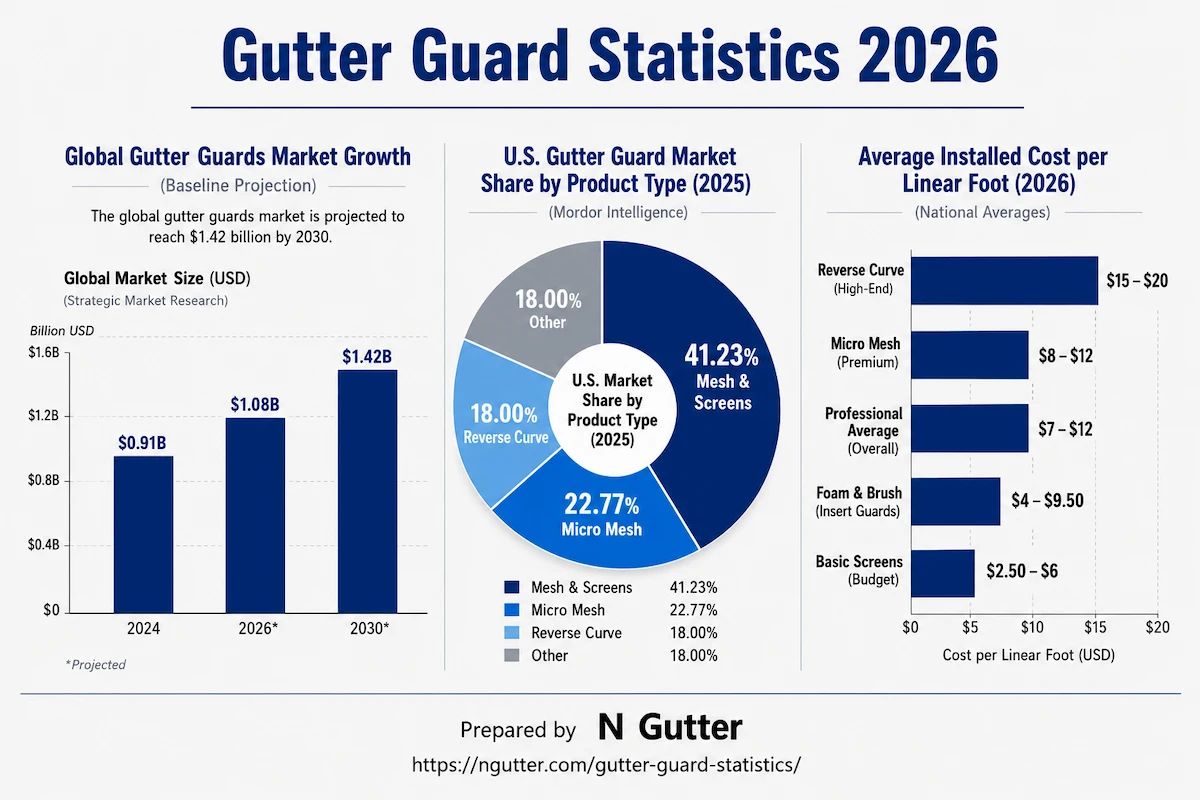
Global Gutter Guards Market Baseline: The global gutter guards market grew from $910 million in 2024 and is projected to reach $1.42 billion by 2030, reflecting a 7.7% compound annual growth rate. Source: Strategic Market Research
Gutter Guard Market Outlook: A second global analysis valued the gutter guard market at $1.2 billion in 2024, projecting it will reach $2.1 billion by 2034 at a 5.8% CAGR. Source: Emergen Research
Gutter Guards Category Sizing: A third study sizing the full gutter guards category at $1.68 billion in 2024 forecasts growth to $2.65 billion by 2033 at a 5.2% CAGR. Source: Growth Market Reports
United States Market Value: The U.S. gutter guards market was valued at $1.11 billion in 2025 and is estimated to grow from $1.16 billion in 2026 to $1.43 billion by 2031 at a 4.24% CAGR. Source: Mordor Intelligence
Billion Dollar Benchmark: Market research confirms the U.S. gutter guard market has officially surpassed $1.1 billion, signaling widespread and growing adoption nationwide. Source: The Hartford
Aging Housing Stock: The median age of owner occupied homes has reached 41 years, and 48% of the housing stock was built before 1980, keeping retrofit demand for gutter protection resilient. Source: NAHB via Mordor Intelligence
New Construction Momentum: U.S. housing starts reached 1.42 million units in 2024, a 12% increase from the previous year, and every new home represents a fresh gutter guard candidate. Source: U.S. Census Bureau via Emergen Research
Extreme Weather Driver: Extreme precipitation events increased 23% between 2020 and 2024 compared with the previous decade, intensifying debris loads and overflow risk on unprotected gutters. Source: National Weather Service via Emergen Research
While gutter guards keep debris out of your system, the gutters underneath still carry the workload. For the latest numbers read our complete breakdown of gutter statistics and plan your next exterior upgrade with confidence.
2. Gutter Guard Product and Material Trends
Gutter guard trends in 2026 point clearly toward finer filtration and longer lasting materials.
Homeowners are moving away from basic plastic screens toward engineered mesh systems, while contractors increasingly bundle premium guards into reroofing and gutter replacement projects.
Material science now drives product differentiation, with stainless steel and aluminum competing on corrosion resistance, fire performance, and lifespan. The following gutter guards data shows where the product mix is heading.
Mesh Market Leadership: Mesh gutter guards dominated global product share in 2024, accounting for over 38% of the market thanks to fine filtration and broad roof compatibility. Source: Strategic Market Research
Screens Lead U.S. Volume: Standard mesh and screen products held 41.23% of the U.S. gutter guards market share in 2025, the largest single product category. Source: Mordor Intelligence
Micro Mesh Momentum: Micro mesh screens are the fastest growing product type in the U.S. market, advancing at a 4.64% CAGR through 2031. Source: Mordor Intelligence
Aluminum Material Dominance: Aluminum gutter guards captured 51.82% of U.S. market revenue in 2025, while stainless steel recorded the fastest material growth at a 4.98% CAGR. Source: Mordor Intelligence
Filtration Performance: In controlled testing, a 275 micron surgical grade stainless steel micro mesh screen blocked over 90% of debris while maintaining strong water flow during simulated downpours.
Product Lifespan Spread: Perforated aluminum and reverse curve guards last 10 to 20 years or more, while foam inserts typically need replacement every 2 to 5 years, making lifespan a core factor in total cost of ownership. Source: HomeGuide
Mesh and Screen Preference: Meshes and screens account for nearly half of all U.S. gutter guard demand in linear feet, while plastic guards represent nearly 25% of absolute demand gains on versatility and price. Source: The Freedonia Group
Wildfire Code Demand: Wildfire codes in states such as California and Colorado require flammable debris to be kept out of gutters, positioning metal gutter guards as a code friendly compliance path. Source: The Freedonia Group
Fire Exposure Scale: More than 60,000 U.S. communities sit in wildland urban interface zones at risk of fire, and an average of more than 3,000 structures per year were lost to fires in these areas between 2002 and 2016. Source: U.S. Fire Administration
3. Gutter Guard Pricing Statistics
Gutter guard pricing statistics show a wide spread between DIY friendly materials and professionally installed systems. Material choice, roof pitch, total linear footage, and local labor rates all move the final number, which is why national averages serve best as planning benchmarks.
Here is what homeowners are actually paying in 2026, from budget screens to premium micro mesh systems.
National Installation Average: Professional gutter guard installation averages $7 to $12 per linear foot, or roughly $1,400 to $2,400 for a typical home.
Reverse Curve Pricing: Reverse curve systems cost $15 to $20 per linear foot installed, the premium tier of the market.
Micro Mesh Pricing: Professionally installed micro mesh guards run $8 to $12 per linear foot.
Screen Pricing: Basic screen guards cost $2.50 to $6 per linear foot installed, the most budget friendly professional option.
Foam and Brush Pricing: Foam inserts average $4.50 to $9.50 and brush guards $4 to $8 per linear foot installed.
Material Only Costs: For DIY buyers, material prices per linear foot range from $0.50 to $1 for plastic screens, $1.50 to $3.50 for foam, $2 to $5 for micro mesh, and $3.50 to $10 for reverse curve covers.
National Brand Pricing: A November 2025 survey of 1,000 gutter guard customers found the following average costs per linear foot by provider. Source: This Old House
- LeafGuard: $21.67 per linear foot
- LeafFilter: $22.66 per linear foot
- All American Gutter Protection: $22.81 per linear foot
- Gutter Guards America: $23.35 per linear foot
- Homecraft: $25.84 per linear foot
Resale Return: Gutter guards return between 0% and 10% of installation cost at resale, meaning the real payback comes from maintenance savings and damage prevention rather than added home value.
4. Gutter Guard Maintenance and Cleaning Statistics
The core promise of gutter protection is simple: fewer cleanings, fewer ladder climbs, and lower lifetime upkeep costs. The gutter guards data from national homeowner surveys largely backs that promise, though no system eliminates maintenance entirely.
Cleaning Frequency Drop: Before installation, 41% of homeowners cleaned their gutters at least once a year and 34% cleaned twice annually. After installation, nearly 30% never clean their gutters at all, and only 22% still clean twice a year. Source: This Old House
Annual Time Savings: About 30% of homeowners save one to two hours of gutter maintenance per year with guards, 42% save four to eight hours, and 24% save eight hours or more. Source: This Old House
Professional Cleaning Cost: The average gutter cleaning service costs $167 per visit, with most homeowners spending between $119 and $234, or $0.95 to $2.25 per linear foot. Source: Angi
Warranty Protection: 87% of gutter guard installations come with warranty coverage, and 99% of warranty holders report confidence in their protection. Source: This Old House
Ladder Injury Volume: DIY gutter cleaning contributes to approximately 500,000 emergency room visits and 300 deaths annually from ladder falls, a risk profile that drives many guard purchases. Source: CPSC via Clean Pro Gutter Cleaning
Overflow Damage Costs: A minor basement flood caught early can cost $500 to $1,500 to repair, while delayed cleanup that leads to mold growth can cost up to $10,000 to remediate. Source: LeafFilter
5. Gutter Guard Consumer Insights
Gutter guard insights from national surveys reveal a buyer who is motivated by prevention, influenced by personal recommendation, and overwhelmingly satisfied after purchase.
For contractors, these numbers define the modern gutter protection customer and how to win their business.
Primary Purchase Motivation: About 70% of homeowners installed gutter guards to prevent clogs or flooding in their gutters.
Value Satisfaction: 69% of homeowners report being very satisfied with the value of their gutter guards.
Installation Satisfaction: A combined 95% of homeowners who chose professional installation were very satisfied or somewhat satisfied with the overall process and workmanship.
Debris Concerns: Homeowners cited the following debris types as their biggest gutter concerns.
- Leaves: 85%
- Dirt or dust: 44%
- Insect debris: 41%
- Pine needles: 31%
- Pine cones: 25%
- Seeds or helicopters: 18%
- Shingle grit: 15%
Professional Preference: 57% of buyers always planned to hire a professional, 38% considered DIY and decided against it, and 5% were unaware DIY options existed.
Decision Drivers: Advice from family, friends, and neighbors was the deciding factor for 44% of homeowners when choosing a gutter guard provider, followed closely by online research at 43%.
Provider Market Share: LeafGuard captured nearly 32% of installations among surveyed homeowners, followed by LeafFilter at nearly 18% and Gutter Guards America at close to 15%.
Installation Seasonality: 38% of gutter guard installations happen in summer and 35% in spring, with 53% of homeowners citing better weather conditions as the reason for their timing.
6. Gutter Guards Data on Water Damage and Safety
The financial case for gutter guards rests on what they prevent. Water damage remains one of the most common and costly homeowners insurance categories, and clogged gutters sit on the recognized list of culprits. These gutter guard statistics quantify the risk side of the equation.
Insurance Claim Connection: Overflowing gutters contribute to up to 22.6% of water related home insurance claims. Source: The Hartford
Claim Frequency: About 1 in 60 insured homes files a water damage or freezing claim each year. Source: RubyHome
Daily Impact: Roughly 14,000 people in the U.S. experience a water damage emergency at home or work every day. Source: RubyHome
Basement Exposure: 98% of U.S. basements will experience some form of water damage during the life of the home. Source: RubyHome
Annual Insurer Cost: Water damage claims cost insurers approximately $13 billion per year. Source: ConsumerAffairs
Prevention Gap: Fewer than 20% of homeowners say they take precautionary steps to protect their home against water damage, despite the known risks. Source: Chubb via ConsumerAffairs
Single Inch Damage: One inch of water can cause up to $25,000 worth of damage to a home. Source: FEMA via Guardian Service
7. Gutter Guard Regional and Commercial Insights
Adoption is not uniform. Regional weather, tree cover, and housing patterns shape where gutter guards sell fastest, while commercial properties emerge as the next growth frontier for installers and manufacturers.
Southern Leadership: The South held 34.84% of the U.S. gutter guards market share in 2025, driven by tropical systems and severe thunderstorm activity. Source: Mordor Intelligence
Fastest Growing Region: The West is projected to grow at a 5.34% CAGR through 2031, propelled by wildfire interface requirements and Pacific Northwest rainfall. Source: Mordor Intelligence
Residential Dominance: Residential applications accounted for 71.61% of the U.S. gutter guards market in 2025. Source: Mordor Intelligence
Commercial Growth: The commercial segment is advancing at a 5.12% CAGR through 2031 as property managers pursue longer service intervals and liability reduction. Source: Mordor Intelligence
North American Share: North America accounts for over 45% of global gutter guard revenue in 2024, making it the most mature regional market. Source: Strategic Market Research
Global Regional Split: In 2024, North America represented $650 million of the global gutter guards market, followed by Europe at $420 million and Asia Pacific at $320 million, with Asia Pacific ranked as the fastest growing region. Source: Growth Market Reports
Regional Buyer Priorities: Cost and effectiveness tie as the top purchase priorities in the South at 60% each and in the West at 63% each, while 63% of Northeast buyers rank effectiveness first. Source: This Old House
The Future of Gutter Guards
The gutter guard industry is shifting from an optional add on to a standard component of whole home water management. These gutter guard statistics point to a market where documented performance, warranty strength, and fire rated materials increasingly separate premium systems from commodity products.
For homeowners, the data carries a clear message. Gutter protection pays for itself through avoided cleaning costs, reduced ladder risk, and protection against water damage claims that average nearly $14,000.
The strongest gutter guard growth trends favor micro mesh filtration, metal construction, and professional installation backed by transferable warranties.
For contractors, gutter guard insights from national surveys show a customer who buys on referral, values warranty coverage, and rarely regrets the purchase.
Businesses that present verified gutter guards data during the estimate, rather than vague promises, will capture the premium tier of this expanding market.
As precipitation extremes intensify and insurers push preventive maintenance, expect gutter guard adoption to keep climbing through 2030 and beyond. The question for most homeowners is no longer whether to install gutter guards. It is which system, which material, and which installer.