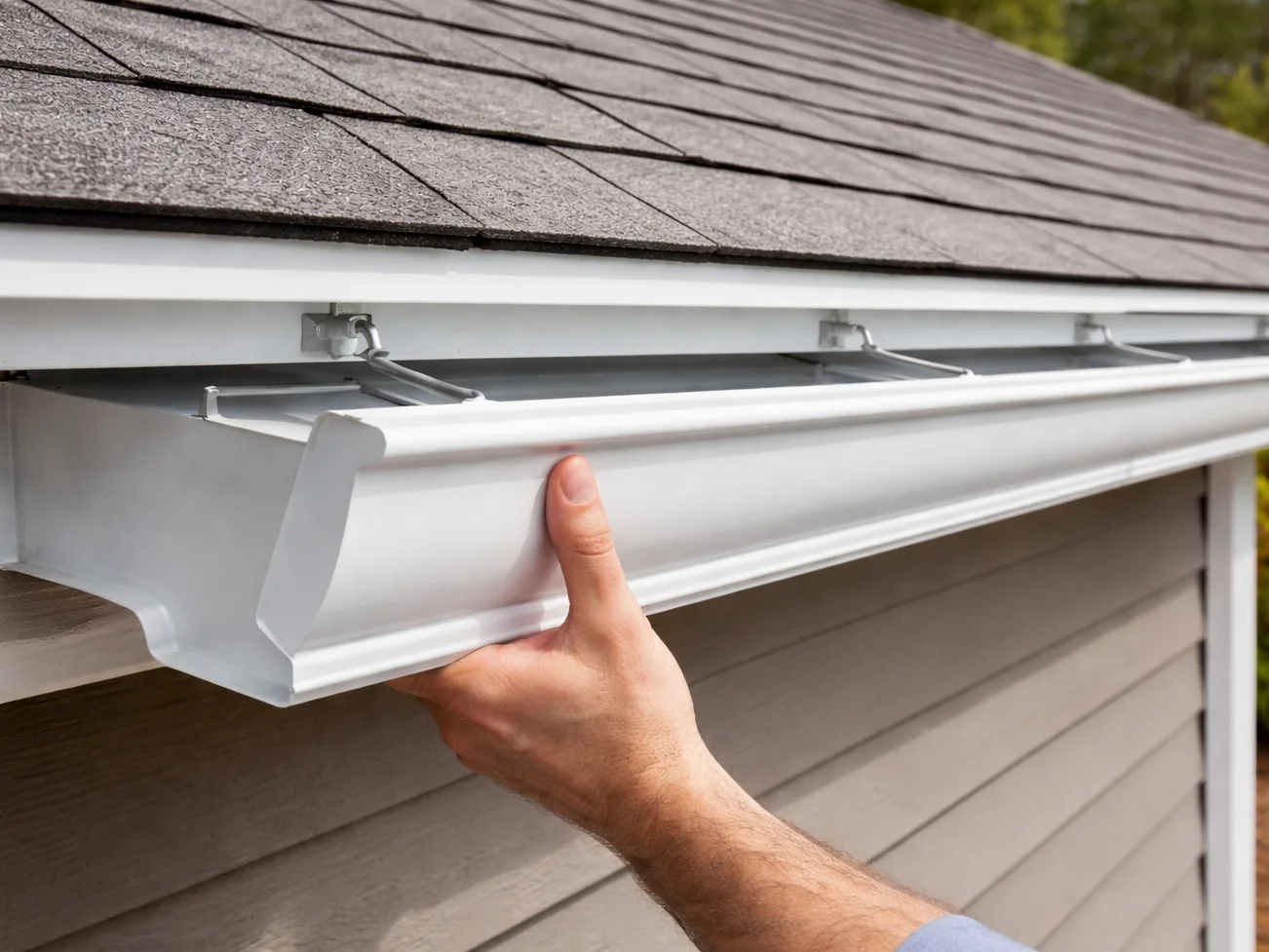
Thinking about taking on a DIY gutter installation? Installing them yourself is a realistic project, and the savings over hiring out can be significant.
This guide walks through every stage of how to install gutters yourself from planning your layout to running a final water test, with the kind of specifics that actually make a difference on the job.
Why Your Gutters Are Doing More Work Than You Realize
A functioning gutter system is responsible for moving thousands of gallons of rainwater away from your home every year.
Without it, that water saturates the soil around your foundation, which causes settling and cracking over time. It also wicks behind siding, creating conditions for rot and mold that are expensive to remediate.
For homes in areas with heavy seasonal rainfall or freeze-thaw cycles, an undersized or improperly installed system compounds the problem fast.
Downspout placement, gutter pitch, and hanger frequency all affect whether water moves the way it should.
Getting those details right from the start is what separates a gutter system that lasts 20 years from one that starts pulling away from the fascia after the first hard winter.
DIY Gutter Installation: Everything You Need
Gathering everything before you start to do gutters saves you from mid-project hardware runs. Here’s what you’ll need:
Tools
- Sturdy ladder with a stabilizer arm
- Tape measure
- Chalk line
- Cordless drill with bits
- Tin snips or a hacksaw with a fine-tooth blade
- Gutter-rated caulk gun and sealant
- Safety glasses and gloves
Materials
- Aluminum or vinyl gutter sections (5-inch K-style is most common for residential)
- End caps, slip connectors, and inside/outside miters
- Downspouts, elbows, and downspout straps
- Hidden hanger brackets
- Rust-resistant hex-head screws
- Outlet holes and drop outlets
- Splash blocks or downspout extensions
Aluminum is worth the modest price difference over vinyl if your home is in a climate with wide temperature swings. It expands and contracts less, holds fasteners better, and doesn’t become brittle over time.
How to Install Gutters: A Step-by-Step Guide
1. Measure and Plan Your Layout
Walk each eave and measure the total linear footage. Mark where downspouts will go before you order materials.
The general rule is one downspout per 30 to 40 linear feet of gutter, but roof pitch and local rainfall totals affect that number. A steep roof sheds water faster and may need outlets spaced closer together.
Think through where the discharged water actually goes. Downspouts should empty onto ground that slopes away from the house, not toward a walkway or an adjacent structure’s foundation.
2. Set the Slope With a Chalk Line
Consistent flow depends on a consistent pitch. Snap a chalk line along the fascia that drops roughly 1/4 inch per 10 feet in the direction of each outlet.
On runs longer than 40 feet, pitching from the midpoint toward a downspout at each end keeps the gutter line looking level from the ground while still draining properly.
Take your time with this step. Redoing the chalk line costs a few minutes. Redoing gutters that hold standing water costs significantly more.
3. Cut Sections and Dry-Fit Before You Commit
Cut gutter lengths to size with tin snips or a hacksaw. Before applying any sealant, dry-fit the whole run including end caps, inside corners, and connectors.
This lets you confirm that your seams land in accessible spots and that joints overlap in the direction water flows, which reduces the chance of seepage at any connection point.
It also reveals fit issues with mitered corners early, while adjustments are still easy to make.
4. Install Hangers the Right Way
Hidden hangers give a cleaner appearance than spike-and-ferrule systems and hold much more securely over time.
Space them 18 to 24 inches apart along the fascia, tightening to 16 inches in climates that see significant snow or ice loads.
Where possible, drive screws through the fascia and into the rafter tails behind it.
Fascia alone, especially on older homes where it may have some weathering, doesn’t provide the same pull-out resistance. This matters most in late winter when gutters are carrying the weight of melting snow.
5. Hang the Gutters
Set the back of the gutter under the drip edge so water sheds cleanly into the trough rather than running behind it. If your roof has no drip edge, install a gutter apron first.
Follow the chalk line carefully as you go, checking the slope periodically rather than assuming the fascia is straight enough to guide you.
Secure each hanger as you work down the run. Trying to adjust slope after a full section is hung is frustrating and usually inaccurate.
6. Install Downspouts and Direct Water Away From the Foundation
Mark and cut outlet holes, then attach the drop outlets and connecting elbows. Downspouts should run tight to the wall, with straps anchored every four to six feet.
At grade, use a bottom elbow to direct water at least four feet from the foundation, either through an extension or a buried drain line if your grading doesn’t provide natural runoff.
Elbows at the top of the downspout (offset elbows) let you work around soffits or architectural details that would otherwise push the downspout away from the wall.
7. Seal Every Joint Thoroughly
Apply gutter-rated sealant inside every end cap, slip connector, and miter joint. Run a bead along the full seam, then smooth it with a finger or tool so there are no gaps at the edges.
Let the sealant cure fully before testing with water. Most products need 24 hours, longer in cool or humid conditions.
Avoid working in temperatures below 40°F. Sealant doesn’t cure properly in the cold and will fail earlier than expected.
8. Test, Adjust, and Fine-Tune
Run a garden hose from the high end of each gutter run and watch how water moves. Look for any spot where it slows, pools, or backs up.
A slight adjustment to hanger height can correct most slope issues. At roof valleys where heavy flow tends to overshoot the gutter, add a splash guard to keep water inside the profile.
Check all sealed joints for weeping and apply additional sealant where needed before calling the job done.
Mistakes DIYers Make on Their First Gutter Install
- Skipping the dry-fit step is the most common one. A section that looks like it’ll fit often reveals a gap or poor angle when you actually hold it in place.
- The second most frequent issue is not accounting for fascia irregularities when snapping the chalk line. Fascia boards bow, especially on older homes, and following the board instead of the line results in uneven slope.
- Using standard wood screws instead of rust-resistant fasteners is a mistake that shows up two or three years later when brown streaks start running down the siding. Spend a few extra dollars on the right hardware upfront.
Pro Tips for Gutters That Hold Up
Gutter guards are worth evaluating if your home sits near mature trees. They won’t eliminate maintenance entirely, but they reduce how often you’re climbing a ladder to clear debris. Mesh guards tend to outperform foam inserts over the long term.
Inspect the system after major storms and clear any debris before fall and spring when volume is highest.
Joints are the most vulnerable point in any gutter system, so add those to your annual inspection list along with the fascia behind each hanger.
Soft or punky fascia won’t hold a hanger reliably, and replacing it before rehanging gutters is far easier than dealing with it after.
Gutter Maintenance After Installation
A well-installed gutter system is low-maintenance, not no-maintenance. Twice a year is the minimum for cleaning, and an annual check of sealant joints extends the life of the system considerably.
If you’re in a region where gutters freeze, consider heat cables for runs that consistently develop ice dams.
Resealing a joint takes about 20 minutes. Repairing a saturated wall cavity or replacing rotted fascia boards takes considerably longer and costs much more.
When to Call a Pro Instead
Some situations make DIY installation more complicated than it’s worth.
Multi-story homes with difficult access, rooflines with complex geometry, and homes where the existing fascia needs replacement before gutters can be rehung are all cases where professional installation makes sense.
The gutter installation cost is often easier to justify when the alternative is renting specialized equipment or working at heights that require more than a standard extension ladder.
If you’re unsure about the scope, or how to do gutters, a quick consult with a contractor before you buy materials can save a full redo.
FAQs
What is the correct pitch for residential gutters?
A drop of 1/4 inch per 10 feet toward the outlet is the standard. On very long runs, pitch from the center toward downspouts at each end.
How far apart should gutter hangers be spaced?
Every 18 to 24 inches in most climates. Tighten spacing to 16 inches in areas with heavy snow or ice.
How many downspouts does a typical home need?
Plan for one downspout per 30 to 40 feet of gutter. Steep roofs or high-rainfall areas may need them closer together.
Do I need a gutter apron if I already have a drip edge?
Usually not, but if the drip edge doesn’t direct water cleanly into the trough, an apron solves the problem.
What type of gutter material lasts the longest?
Aluminum is the most practical choice for most homes. Copper lasts longer but costs significantly more. Vinyl is budget-friendly but less durable in temperature extremes.
Need help with a gutter project? Reach out to discuss today.