You climb that ladder twice a year. You scoop rotting leaves, flushed pine needles, and shingle grit from your gutters. You wonder if your shiny new gutter guards actually work or just create expensive new problems.
After installing thousands of systems across every roof type imaginable, I have seen which types of gutter guards deliver on their promises and which ones fail spectacularly. Read on to get real field data and reviews from my installations.
What Are Gutter Guards and Do You Need Them?
Gutter guards are protective barriers that block debris while allowing rainwater to enter your gutter system. They mount over or inside existing gutters. The goal is simple: reduce cleaning frequency and prevent water damage to your foundation, fascia, and landscaping.
But here is the truth most manufacturers hide. No gutter guard eliminates maintenance entirely. Leaves still accumulate on top. Small debris still finds entry points. The question is not whether you will ever clean again. The question is how often and how difficult the cleaning becomes.
A quality guard transforms twice-yearly deep cleanings into quick hose-offs from ground level. A poor choice traps debris, creates ice dams, or damages your roof.
Your home sits near trees. You face specific debris types. Your roof has a particular pitch. These factors determine which of the six main types of gutter guards suits your situation.
The 6 Types of Gutter Guards Compared
Brush Gutter Guards
Brush gutter guards look like giant pipe cleaners. They sit inside your gutter channel, with bristles pointing upward to catch leaves while water flows underneath.
The attraction is obvious. You buy them at any hardware store. You cut them to length with tin snips. You drop them in place without tools. For twenty dollars, you “solve” your gutter problem in an afternoon.
Here is what happens six months later.
Leaves do not bounce off as promised. They impale themselves on the bristles. Small twigs weave between wires. Pine needles thread through like sewing needles. Instead of cleaning empty gutters, you now extract debris tangled in steel wool-like masses. The brushes themselves detach in high winds. Squirrels pull them apart for nesting material.
During heavy rain, the bristles create surface tension that actually slows water entry. Overflow cascades over your gutters, pooling against your foundation. In winter, trapped leaves freeze into solid blocks. The expansion warps your gutter walls.
Brush guards cost two to four dollars per linear foot. They last two to three years before corrosion or UV degradation destroys the bristles. You must remove them completely to clean underneath. This creates twice the work of unprotected gutters.
Foam Gutter Guards
Foam gutter guards are triangular polyurethane wedges that press into your gutter channel. Water filters through the porous material while the top blocks large debris.
Manufacturers love selling these. Retail margins are high. Customer installation eliminates labor costs. The marketing writes itself: “Just slide them in!”
I have pulled thousands of these out of gutters. Here is the reality you need to know.
Foam retains moisture. It breeds mold, algae, and bacteria. In humid climates, the material turns green and spongy. The pores clog with shingle grit and pollen. Instead of filtering water, the foam becomes a dam.
During heavy downpours, the material saturates. Water overflows the gutter edges. In winter, trapped moisture freezes. The expansion cracks the foam and warps gutter seams. By year three, UV exposure turns the material brittle. It crumbles into your gutters, creating the exact clogs you tried to prevent.
Foam guards cost one to three dollars per linear foot. They require complete replacement every two to five years. They void some roof warranties because they trap moisture against fascia boards. For short-term solutions in dry climates, they work temporarily. For permanent protection, they represent false economy.
Screen Gutter Guards
Screen gutter guards are perforated panels that cover your gutter tops. They come in plastic or metal varieties. Large holes allow water through while blocking leaves and twigs.
Screens represent the minimum viable protection level. They stop the big stuff. Maple leaves, oak catkins, and large twigs slide off or dry on top until wind blows them away. Cleaning means brushing the surface occasionally.
But standard screens have 1/8 to 1/4 inch openings. Pine needles pass through easily. Seed pods slip inside. During heavy rain, water shoots over the screen instead of passing through. The openings themselves clog with small debris, requiring you to scrub each hole.
Plastic screens degrade quickly. UV radiation makes them brittle within two years. They crack under snow load or falling branches. Metal screens last longer but cost more. Neither variant handles fine debris well.
Screens work best on homes with large-leaf trees, gentle rainfall patterns, and moderate temperatures. They cost three to eight dollars per linear foot depending on material. Expect five to ten years of service from metal versions, two to five from plastic.
Mesh Gutter Guards
Mesh gutter guards use finer perforated metal than screens. Openings typically measure 1/16 inch or smaller. They balance debris blocking with water flow better than basic screens.
Installation methods vary. Some clip to the front lip and slide under the first row of shingles. Others attach with screws directly to the gutter hem. The under-shingle method creates a slope that encourages debris shedding. However, it risks roof warranty violations if not installed carefully.
Mesh stops most leaves and twigs. Small debris like shingle grit and tiny seeds still enter, but the accumulation happens slowly. You clean gutters every two to three years instead of twice yearly.
Stainless steel mesh outlasts aluminum or vinyl variants. It resists corrosion from acidic leaf tannins and salt air. Powder-coated steel offers good durability at lower cost. Avoid plastic mesh entirely. It becomes brittle and cracks within three years.
Mesh guards cost five to fifteen dollars per linear foot installed. They last fifteen to twenty years with occasional maintenance. For homes with mixed tree cover and moderate rainfall, they represent the best value proposition.
Micro-Mesh Gutter Guards
Micro-mesh gutter guards use stainless steel with openings around 275 microns. This blocks everything except water molecules and the finest dust particles.
If you live near pine trees, you need micro-mesh. Pine needles cannot penetrate. Pollen washes away. Roof grit stays out. The surface tension created by the fine mesh actually pulls water through even during intense downpours.
Quality systems use three-piece construction. The mesh attaches to a rigid frame supported by structural hangers. This creates a completely sealed system. No debris enters from above, below, or through seams.
Installation requires professional expertise. The guards must follow your roof pitch exactly. Too flat, and debris accumulates. Too steep, and water overshoots the gutters entirely. Some systems install under shingles, risking warranty issues. Others use fascia-mount brackets that avoid roof penetration.
Micro-mesh costs fifteen to twenty-five dollars per linear foot installed. Lifespan exceeds twenty years. Most manufacturers offer transferable lifetime warranties. For heavy tree cover, fine debris environments, or homes where ladder access is dangerous, this is the premium solution.
Reverse Curve Gutter Guards
Reverse curve guards, also called gutter helmets, use physics instead of filtration. A curved cover extends past the gutter lip. Water follows the curve due to surface tension and enters through a narrow slot. Debris falls over the edge.
These systems have existed for decades. They work well for large-leaf trees. They handle heavy rainfall volumes effectively. The solid top prevents almost all debris entry.
But the slot width limits water entry during deluges. Intense storms overwhelm the system, sending water over the gutters entirely. Small debris like pine needles often follows the water curve into the gutter. The curved profile is visible from ground level, creating aesthetic concerns for some homeowners.
Installation requires sliding the back edge under your shingles. This disturbs roofing materials and often voids manufacturer warranties. Poor installation creates entry points for bees and rodents. Ice dams form easily because the solid top prevents sun from warming the gutter interior.
Reverse curve systems cost ten to twenty dollars per linear foot. They last twenty years with proper installation. Consider these only if you have large-leaf trees, professional installation expertise, and roof warranty flexibility.
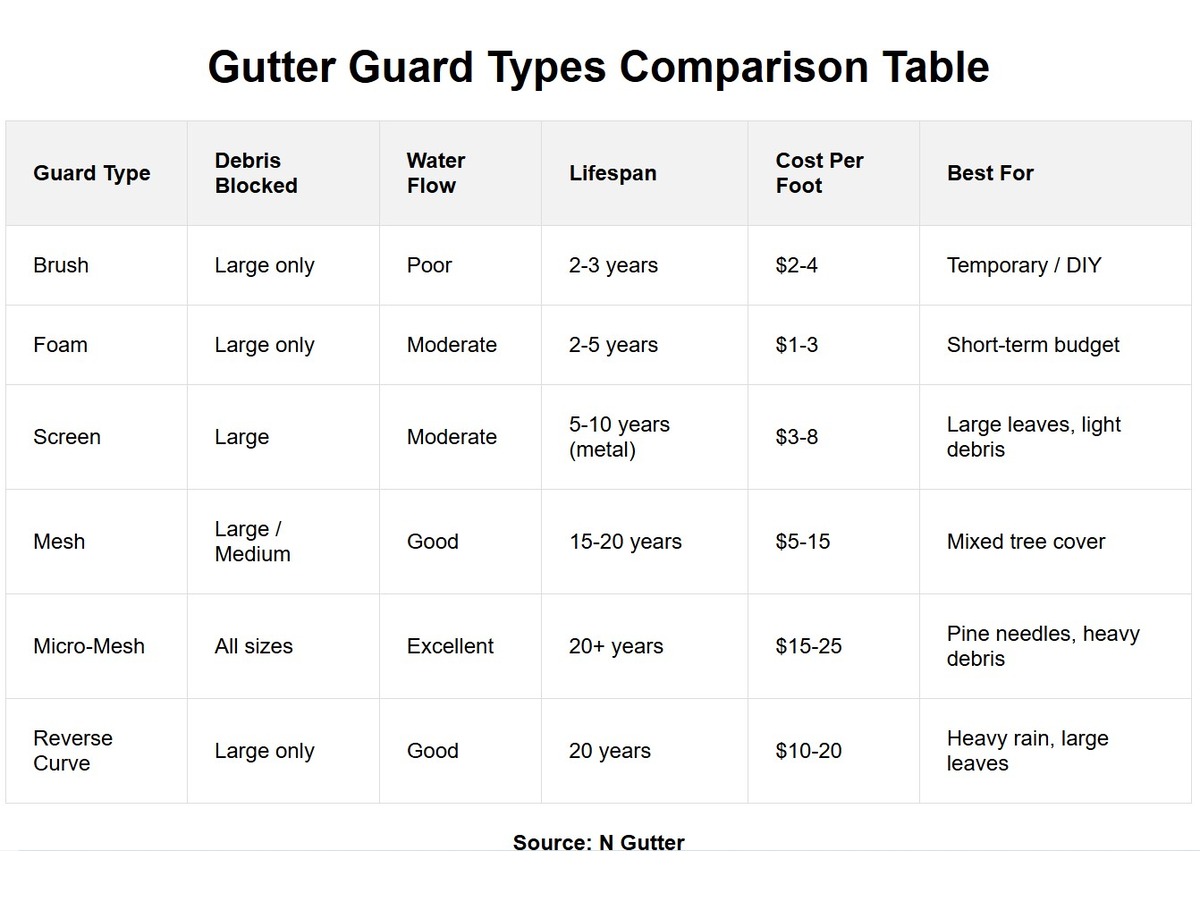
Gutter Guard Types Comparison Table
| Guard Type | Debris Blocked | Water Flow | Lifespan | Cost Per Foot | Best For |
|---|---|---|---|---|---|
| Brush | Large only | Poor | 2-3 years | $2-4 | Temporary/DIY |
| Foam | Large only | Moderate | 2-5 years | $1-3 | Short-term budget |
| Screen | Large | Moderate | 5-10 years (metal) | $3-8 | Large leaves, light debris |
| Mesh | Large/Medium | Good | 15-20 years | $5-15 | Mixed tree cover |
| Micro-Mesh | All sizes | Excellent | 20+ years | $15-25 | Pine needles, heavy debris |
| Reverse Curve | Large only | Good | 20 years | $10-20 | Heavy rain, large leaves |
How to Choose Gutter Guards?
Your roof determines your guard selection more than your preferences. Steep pitches send water racing. Complex valleys concentrate flow. Metal roofs shed debris differently than asphalt shingles.
Measuring gutter size compatibility first. Standard K-style gutters measure five inches wide. Older homes may have four-inch or six-inch varieties. Oversized guards create gaps. Undersized guards require trimming that weakens the structure.
Climate drives material selection. Snow loads crush plastic guards. Ice dams warp aluminum. Coastal salt air corrodes non-stainless metals. Desert dust clogs fine meshes quickly.
Tree species matter more than tree quantity. Two pine trees produce more gutter-clogging needles than ten oak trees. Maples drop helicopter seeds that wedge in screens. Cottonwoods shed sticky leaf clusters that adhere to mesh.
Consider your roof warranty carefully. Any system requiring shingle lifting or underlayment penetration risks voiding coverage. Check manufacturer documentation before selecting under-shingle installation methods.
Gutter work is dangerous. Falls from ladders cause thousands of injuries annually. Gutter professionals carry insurance and use specialized equipment. They spot underlying problems like rotting fascia or improper pitch that you might miss.
Frequently Asked Questions
What type of gutter guard works best in heavy rain?
Micro-mesh and reverse curve designs handle heavy rainfall best. Micro-mesh uses surface tension to pull water through fine openings even during deluges. Reverse curve systems channel high volumes through wide intake slots. Avoid foam and brush types in heavy rain regions. They saturate and overflow.
Can gutter guards cause roof leaks?
Improperly installed guards cause leaks. Systems that lift shingles or penetrate roofing underlayment create entry points for water. Ice dams form more easily with solid-top guards that prevent gutter warming. Always verify that installation methods comply with your roof warranty terms.
How long do different gutter guard types last?
Brush and foam last 2-5 years. Plastic screens last 2-3 years. Metal screens last 5-10 years. Mesh lasts 15-20 years. Micro-mesh and reverse curve last 20+ years. Lifespan varies by climate, tree cover, and maintenance quality. Stainless steel outlasts aluminum in all environments.