You pull into your driveway after a storm and notice water pouring over your gutters. Is it a clog? A sagging section? Maybe a missing part?
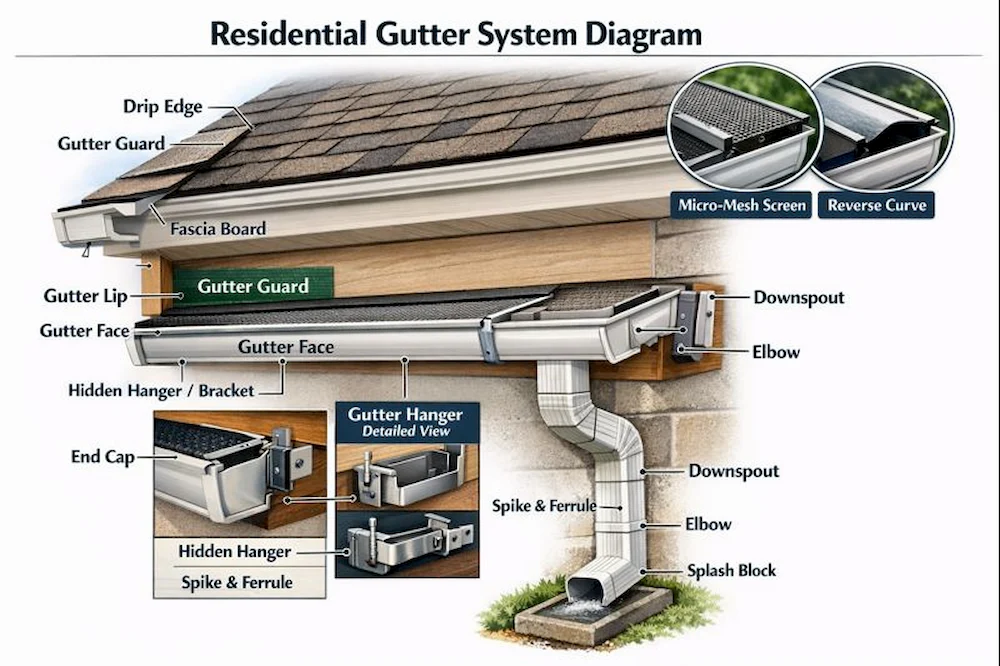
Understanding rain gutter parts helps you diagnose problems fast and talk shop with contractors like a pro. This guide and our gutter diagram infographic breaks down every component in plain language.
What Are the Main Rain Gutter Parts?
A gutter system moves water from your roof to the ground. It has three core sections: collection (gutters), transport (downspouts), and protection (guards and seals).
Each part must work together. One weak link causes overflows, foundation damage, or rotted fascia.
Gutters: The Collection Channel
Gutters are horizontal channels that catch runoff. They come in three shapes.
K-style gutters dominate American homes. They hold more water than half-round styles. Their flat back nails directly to fascia boards. Most contractors use .027 or .032 gauge aluminum for durability. These last 20–30 years with proper care.
Half-round gutters appear on older or high-end homes. They need special hangers installed before the gutter drops in. Half-rounds cost more but handle debris better. Their smooth shape lets leaves wash out easier.
Box gutters hide behind roof trim on commercial buildings. You rarely see them on residential homes.
Downspouts and Elbows: The Transport Team
Downspouts are vertical pipes. They carry water from gutters to the ground. Elbows are angled sections that redirect flow around corners. You will find A-style elbows (two bends) and B-style elbows (one bend) at most hardware stores.
End Caps, Miters, and Slip Joints: The Seals
End caps close gutter ends. They snap on and get sealed with caulk. Miters join gutters at corners. Outside miters handle external corners. Inside miters fit internal corners. Strip miters are small sleeves that cover seams instead of full boxes.
Residential Gutter System
Here is the full list of parts you will encounter in a typical residential gutter system, arranged by how they work together in the system.
What Holds Everything Up
- Fascia Board – This trim board runs behind your gutters and bears all the weight. It is wood that rots quickly when drip edge is missing. Never hang new gutters on soft fascia. Test it by pushing a screwdriver into the wood. If it sinks in, replace the board first.
- Hanger/Bracket – This hardware keeps gutters from falling off the house. Hidden hangers screw into the fascia from inside the gutter. Spike-and-ferrule systems drive a large nail through the gutter face. Quality hangers hold 50 pounds per linear foot. Space them no more than 24 inches apart.
- Hidden Fastener – These screws secure the entire assembly. Self-tapping screws grip far better than traditional nails. Standard fascia needs one-and-a-half-inch screws. Wrapped fascia requires two-inch screws for proper bite.
- Gutter Hanger/Bracket (Detailed) – The true workhorse of the system. Hidden hangers clip onto the gutter’s front lip and screw into the fascia board. Spike-and-ferrule setups punch through the gutter face. Hidden hangers last 25 years. Spikes fail in 5–10 years.
The Gutter Body Itself
- Gutter – The horizontal trough that catches roof runoff. K-style dominates homes because it moves more water. Half-round fits historic houses better. Commercial buildings hide box gutters. Pitch it half an inch per ten feet for proper flow.
- Gutter Bottom – The flat floor where water flows and debris collects. This is the gutter’s basin. Keep it clear or water will pool and overflow.
- Gutter Face – The vertical front wall you see from the ground. This is the gutter’s most visible surface. Paint it every five years to prevent oxidation and keep it looking sharp.
- Gutter Lip – The rolled front edge that provides strength and a finished look. This is the leading edge visible from your lawn. The roll adds rigidity to the entire profile.
- Back Wall – The rear vertical side that sits flat against the fascia. This is where the gutter meets the house. Seal this joint to stop water from wicking behind the system.
Corners and Ends
- End Cap – This piece seals the terminal end of any gutter run. Snap-on caps seem easy but always need polyurethane sealant. Water breaches here first. Inspect end caps each spring.
- Seam/Joint – Where two gutter sections meet. Slip joints telescope inside each other. These spots crack in freeze-thaw climates. Seamless gutters avoid this weak point entirely.
- Inside Miter – The corner connector for interior angles. Strip miters are slim sleeves. Box miters are full corner boxes. Both need sealant on all four seams to stay dry.
- Drain Outlet – The opening where water exits the gutter into the downspout. Some call it a drop outlet. Size must match your downspout exactly. Pop rivets anchor it to the gutter floor.
The Waterway
- Downspout – The vertical pipe that moves water from roof to ground. Most homes use 2×3 inch size. Heavy rain areasvand large roofs need 3×4 inches. Strap it every six feet to prevent wind damage.
- Elbow – Angled sections that redirect downspout flow. A-style elbows make two bends. B-style makes one bend. Install at least one elbow at the top and bottom of each downspout run.
- Splash Block – The pad at the downspout base that directs water away from the foundation. Concrete blocks last for decades. Plastic versions crack in two seasons. Place it three feet from the house.
Guards and Edges
- Drip Edge – Flashing that bridges roof and gutter. It tucks under shingles and extends over the gutter’s back edge. Without it, water curls behind the gutter and rots the fascia. Extend it at least one and a half inches.
- Gutter Guard – A cover that blocks debris but lets water through. Micro-mesh screens stop 90% of everything, including pine needles. Reverse curve designs only work for large leaves. Foam and brush options are short-term band-aids.
- Gutter Guard (Detailed) – The shield against leaves. Micro-mesh employs stainless steel screen. Reverse curve relies on water’s surface tension. Screens show visible holes. Mesh hides nearly invisible ones.
Gutter Hardware Explained
Hardware holds your system to the house. Cheap hardware fails first. You need to know the difference.
Gutter Hangers: Hidden vs. Spike-and-Ferrule
Hidden hangers are the modern standard. They clip inside the gutter and screw into fascia. You cannot see them from the ground. They support 50 pounds per linear foot when spaced 24 inches apart. Hidden hangers last the life of the gutter.
Spike-and-ferrule systems are old technology. A spike (large nail) pierces the gutter face and drives through a ferrule (spacer) into fascia. Spikes work loose as wood expands and contracts. You can only tighten them three to four times before the hole strips out.
Which should you choose? Always specify hidden hangers for new installs. If you have spikes, replace them with gutter screws when they loosen.
Gutter Screws vs. Spikes: Which Lasts Longer?
Gutter screws are threaded spikes. They grip better in worn holes. A 7-inch gutter screw costs $0.50. It outlasts a spike by 10 years. When spikes fail, screws are your best retrofit option.
Gutter Guards: Do They Work?
Gutter guards cut cleaning time. They do not eliminate maintenance. The market confuses homeowners with bold claims. Here is what works.
Micro-Mesh vs. Reverse Curve: Performance Data
Micro-mesh guards use stainless steel screens with tiny holes. They block pine needles and shingle grit. Premium brands like LeafFilter use this design. Testing shows micro-mesh blocks 90% of debris. Water flows through even when the surface is dirty.
Reverse curve guards (Gutter Helmet) use surface tension. Water curves around the edge and drops into the gutter. Leaves fall off the front. These work for large debris but fail in light rain. Slow water does not curve properly. It runs off the front, missing the gutter entirely.
Cost comparison: Micro-mesh runs $22–$24 per linear foot installed. Reverse curve costs $21–$23 per foot. Micro-mesh performs better in all climates.
Foam and Brush Guards: Why Pros Avoid Them
Foam inserts sit inside gutters. They clog with fine debris. Plants grow in them. Mold develops within two years. Brush guards trap leaves and block water flow. Both types need replacement every 2–3 years. Pros never recommend them for permanent solutions.
Roof Integration Parts
Gutters do not work alone. Roof parts protect the edge and direct water.
Drip Edge: The Most Overlooked Component
Drip edge is metal flashing. It slides under shingles and extends over the gutter back. Its job is simple: keep water from curling behind the gutter. Roofers sometimes skip drip edge or install it wrong. This causes fascia rot within five years.
You need drip edge on all eaves and rakes. Use 1.5-inch overhang minimum. Galvanized steel lasts 20 years. Aluminum lasts longer.
Fascia Board: What Homeowners Miss
Fascia board is the wood trim behind gutters. It supports the entire system. Rotten fascia cannot hold hangers. Water gets into your attic. You must replace fascia before installing new gutters.
FAQs
What are the most important rain gutter parts?
Gutters, downspouts, hangers, and drip edge form the core system. Without any one piece, water damages your home.
How long do gutter parts last?
Aluminum gutters last 20–30 years. Hidden hangers last 25 years. Spikes last 5–10 years. Micro-mesh guards last 20 years. Foam guards last 2–3 years.
Can I mix gutter parts from different brands?
Yes, if dimensions match. K-style gutters are standardized. Hangers and guards vary. Check compatibility before buying.