This guide compiles the latest Pennsylvania roofing statistics for 2026, sourced from government agencies, industry research firms, and market analysts.
Discover insights about the unique Pennsylvania roofing data and trends shaped by aging housing stock, harsh seasonal weather, and evolving energy codes.
Below, you can explore the latest insights, consumer behaviors, and key growth areas shaping the roofing and roof maintenance landscape in PA.
1. Pennsylvania Roofing Market & Growth Trends
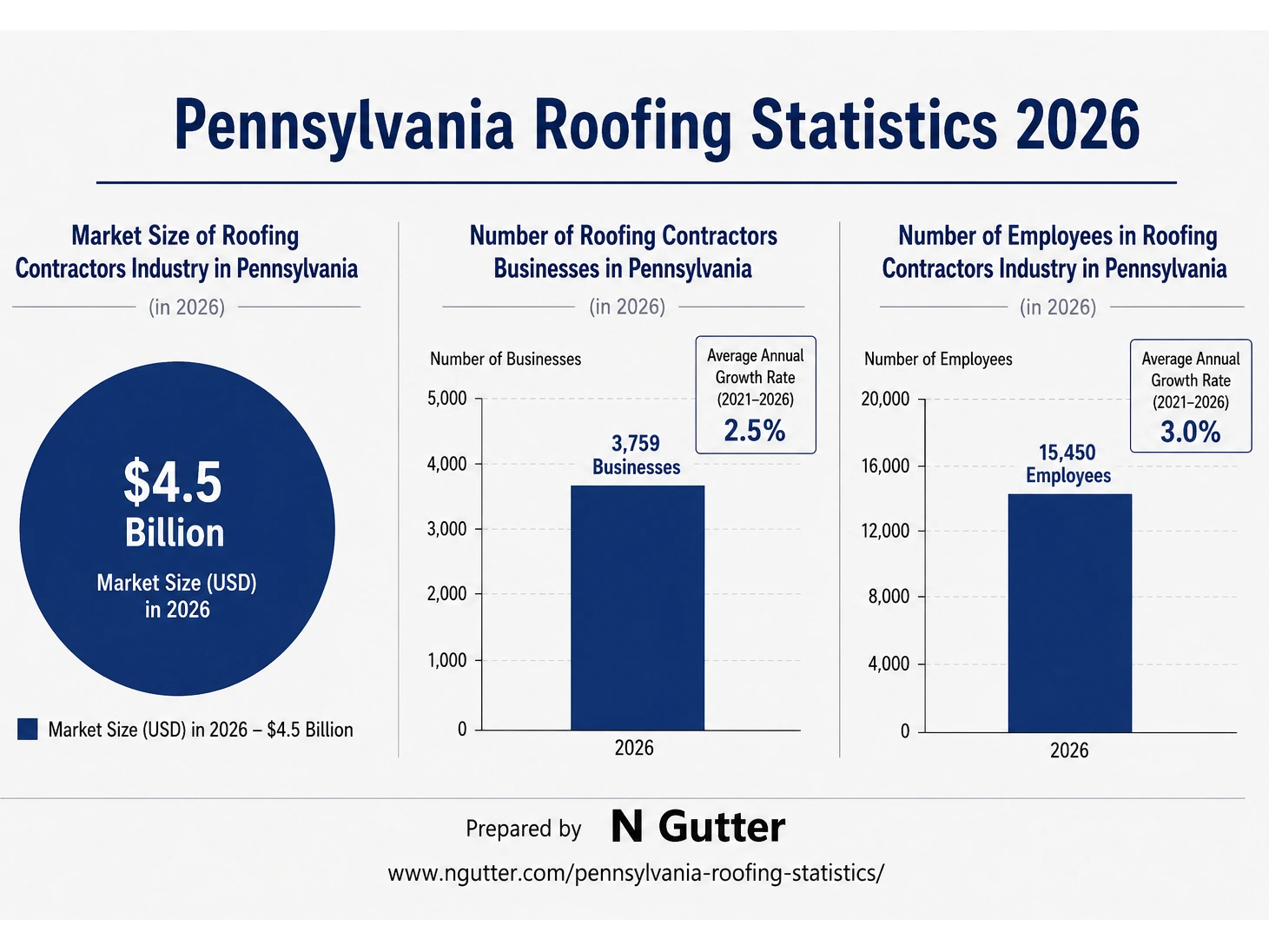
The roofing market in Pennsylvania is substantial and growing. The market size of the Roofing Contractors industry in Pennsylvania reached $4.5 billion in 2026, reflecting steady demand across residential, commercial, and institutional sectors.
Source: IBISWorld
Pennsylvania’s housing stock provides the foundation for this demand.
The state contains 5,882,221 housing units as of July 2025, with a homeownership rate of 69.3% between 2020 and 2024.
Source: U.S. Census Bureau
Approximately 76% of homes in Pennsylvania are single-family structures, the building type most likely to require individual roof replacement and maintenance over time.
Large multi-family units represent 12% of the housing stock, while small multi-family buildings of two to four units account for 9%.
Source: Pennsylvania Housing Finance Agency
Nationally, the U.S. roofing market was valued at USD 31.50 billion in 2025 and is anticipated to reach USD 33.47 billion in 2026.
The market is projected to grow to USD 54.36 billion by 2034, expanding at a compound annual growth rate (CAGR) of 6.25% from 2026 to 2034.
Source: Market Data Forecast
Protecting your Pennsylvania home requires a complete exterior system, not just a quality roof. Proper water management through gutters and downspouts works hand-in-hand with your roofing investment to prevent water damage, foundation erosion, and ice dam formation. For a data-driven look explore our comprehensive guide on gutter statistics and see how seamless systems and gutter guards complement your roofing strategy.
Aging Housing Stock Drives Replacement Demand
Pennsylvania’s aging housing stock is a primary driver of roofing demand. In multiple counties, a significant share of homes were built over 85 years ago:
- Berks County: About one in three homes built over 85 years ago
- Cambria County: About one in three homes built over 85 years ago
- Schuylkill County: Nearly half of all homes built over 85 years ago
- Crawford County: Close to one in four homes built over 85 years ago
- Lancaster County: About one in five homes built over 85 years ago
- Lackawanna County: More than one in three homes built over 85 years ago
Source: Housing Alliance of Pennsylvania
Nationally, 44% of single-family homes are 30 years or older, placing many Pennsylvania properties well into their first or second major roof replacement cycle.
With the average lifespan of standard asphalt shingles ranging from 15 to 20 years, the replacement pipeline remains full regardless of new construction trends.
Source: Market Data Forecast
2. Pennsylvania Roofing Material Innovation & Lifespan
Material selection shapes both upfront costs and long-term performance. Pennsylvania homeowners choose from a range of options, each with distinct lifespans and price points.
Material Lifespan Comparison
| Material | Typical Lifespan | PA Cost Range (per sq ft) |
|---|---|---|
| Builder-Grade Asphalt Shingles | 15-20 years | $3.00 – $4.00 |
| Standard/Architectural Shingles | 25-40 years | $4.50 – $6.50 |
| Metal Roofing | 40-50+ years | $8.00 – $15.90 |
| Slate and Tile Roofing | 50+ years | $12.00 – $30.00 |
| Wood Shakes/Shingles | 30-50 years | $7.00 – $12.00 |
Asphalt shingles continue to dominate the U.S. roofing market, holding 58.6% of revenue share in 2025.
Owens Corning reported that the U.S. asphalt shingle market totaled 160 million squares in 2024, with 135 million squares coming from reroof and repair activity rather than new construction.
Laminate products now account for 95% of shingle demand, indicating the market has shifted away from standard 3-tab products toward higher-value laminated systems.
Metal roofing is the fastest-growing material segment, projected to expand at a CAGR of 7.4% from 2026 to 2034. Metal roofs can last 40 to 70 years, significantly outlasting traditional asphalt shingles.
The Insurance Institute for Business and Home Safety reports that homes with metal roofs may qualify for insurance discounts due to their resilience against fire, wind, and hail.
Source: Market Data Forecast
Single-ply membranes (TPO, EPDM, and PVC) are forecast to grow at a 7.69% CAGR through 2031, making them the fastest-growing material category in commercial applications. GAF opened a 425,000-square-foot TPO plant in Valdosta, Georgia in September 2024 to meet rising demand.
Source: Mordor Intelligence
Key Material Trends
- Sustainable roofing materials are gaining market share as green building certifications expand
- Solar roofing integration is rising, with solar-ready panels growing by 31%
- Cool roof coatings exceeding 70% reflectivity are growing by 41%
- Prefabricated panel usage is increasing by 29%
- Class 4 impact-resistant shingles are gaining ground in hail-prone regions where insurers reward stronger roof performance
Source: Business Research Insights
3. Roofing & Efficiency in Pennsylvania
2026 Energy Code Updates for Pennsylvania
Energy efficiency is reshaping roofing specifications across Pennsylvania. The state adopted the 2021 International Energy Conservation Code (IECC) as part of its Uniform Construction Code, effective January 1, 2026.
Any design or construction contract executed on or after this date, or permit applications submitted on or after July 1, 2026, must comply with the updated standards.
- Building envelope performance: Updated requirements for insulation values, air sealing, and thermal performance
- Energy Recovery Ventilators (ERVs): Required under the prescriptive path for all dwelling units
- Expanded commissioning requirements: More defined and stringent, making enforcement more consistent
- Increased baseline efficiency: All code pathways require higher energy efficiency for building envelope and lighting components
Metal roofing offers significant efficiency advantages. Durability above 40 years influences nearly 68% of buyers, while energy savings of 10-25% drive 47% of adoption. Cool roof coatings with reflectivity exceeding 70% are growing rapidly as building owners seek to reduce cooling loads.
Source: Business Research Insights
Solar roofing is gaining momentum in Pennsylvania. The state has become one of the nation’s fastest-growing solar markets, doubling solar capacity to over 2 gigawatts in just 17 months.
Rooftop installations now make up about two-thirds of Pennsylvania’s total solar capacity. Solar projects increased 160% over the past five years.
Pennsylvania offers 1:1 net metering through major utilities including PECO, PPL, and Met-Ed, meaning every kilowatt-hour of excess energy earns full retail rate credits.
Additionally, Solar Renewable Energy Credits (SRECs) pay Pennsylvania solar owners between $30 and $40 per megawatt-hour generated, with a typical 5-kilowatt residential system generating approximately $400 to $600 annually from SRECs alone.
Reflective roofing interests 42% of homeowners nationally, and the cool roof market is expanding as Pennsylvania summers grow warmer. The global solar roof market is estimated at USD 6.56 billion in 2026 and is expected to reach USD 14.15 billion by 2033, growing at a CAGR of 11.6%.
Source: Coherent Market Insights
4. Pennsylvania Roofing Maintenance & Service Statistics
Average Roof Replacement Costs in Pennsylvania
| Region/Material | Cost Range | Notes |
|---|---|---|
| Statewide Average (2,000 sq ft, asphalt) | $12,500 – $18,500 | Most common range for typical home |
| Central PA (Shingle Roofs) | $14,000 – $44,000 | Varies by home size and complexity |
| Central PA (Metal Roofs) | $10,000 – $50,000+ | Standing seam at higher end |
| Pittsburgh Area | $8,000 – $20,000 | Complete replacement |
| Main Line PA | $12,500+ | Standard asphalt shingle |
| Per Square Foot (PA Average) | $4.50 – $10.00 | Includes materials and labor |
Source: Modernize
Materials and labor account for approximately 60% of total roof replacement costs in Central Pennsylvania, with labor alone representing up to 50% of the total. Labor typically costs $2.00 to $4.50 per square foot in Pennsylvania.
Roof complexity significantly impacts pricing. Steep or complex pitches increase total cost by an additional 10-25% due to added safety equipment and labor time. Features like chimneys add $300 to $1,000+, while skylights add $800 to $2,500+ per unit.
Seasonal timing affects pricing. The peak roofing season in Pennsylvania runs from April to October, when demand is highest. Scheduling during the off-season (late fall or winter) can sometimes reduce labor costs, though weather conditions may limit workable days.
Insurance and Storm Damage in Pennsylvania
Storm damage represents a major source of roofing work. Nationally, 38% of roofing jobs are part of an insurance claim, and 22% of projects originate from storm damage. Hail damage alone accounts for 45.5% of all homeowners insurance claims nationwide, with an average claim cost of $11,695.
Source: Cape Analytics
Pennsylvania has historically ranked among the top states for hail-related insurance claims. Reports from The Weather Channel indicated that Pennsylvania came in seventh on a list of 10 states for insurance claims related to hail. In Bucks County, average hail or wind claim values range from $10,000 to $26,000 depending on roof size and damage severity.
In 2024, over 12 million properties were hit by hail nationwide. After major storms, insurance claims spike by 65%, and approximately 35% of homeowners delay repairs due to deductible concerns.
5. US Roofing Industry Statistics
The broader U.S. roofing industry provides context for Pennsylvania’s market position and trends.
The U.S. Roofing Contractors industry generated $92.5 billion in revenue in 2026, with the market growing at a CAGR of 5.0% between 2021 and 2026. There are approximately 109,000 roofing contractor businesses operating across the United States.
Source: IBISWorld
The global roofing market was valued at USD 126.59 billion in 2025 and is predicted to increase to USD 132.07 billion in 2026, reaching approximately USD 192.03 billion by 2035 at a CAGR of 4.26%. North America is expected to witness the fastest growth during the forecast period.
Source: Precedence Research
By construction type, reroofing and replacement accounted for 63.5% of revenue in 2025, while new construction is projected to grow at a 6.97% CAGR through 2031. By application, residential roofing captured 58% of market share in 2025, while commercial roofing is expected to advance at the fastest rate, an 8.05% CAGR through 2031.
Source: Mordor Intelligence
The roofing materials market is projected to grow from USD 143.87 billion in 2025 to USD 148.73 billion in 2026, reaching USD 199.55 billion by 2034 at a 3.60% CAGR. The U.S. roofing materials market alone is projected to reach an estimated value of USD 34.77 billion by 2032.
Source: Fortune Business Insights
Technology Adoption in Roofing
- Drone usage for roof inspections increased 28% through 2025
- AR tools shorten the sales cycle by 42%
- 26% of contractors now offer virtual estimates
- AI-based roof monitoring is integrated in 9% of advanced projects
Source: Business Research Insights
6. Pennsylvania Roofing Contractor Workforce Statistics
Labor availability and cost directly impact project timelines and pricing for Pennsylvania homeowners.
The median annual wage for roofers was $50,970 in May 2024, according to the U.S. Bureau of Labor Statistics. Employment of roofers is projected to grow 6% from 2024 to 2034, faster than the average for all occupations, with about 12,700 openings projected each year over the decade.
Source: U.S. Bureau of Labor Statistics
Construction labor shortages remain acute. 85% of contractors report skilled labor shortages, and 82% of firms report difficulty filling hourly craft positions. Construction job openings reached approximately 212,000 to 240,000 in early 2026, while the construction hiring rate hit 3.3% in February 2026, the lowest on record since JOLTS began in 2000.
The construction industry needs approximately 349,000 net new workers in 2026 and 456,000 in 2027, according to Associated Builders and Contractors. 45% of firms report project delays directly resulting from labor shortages.
Average hourly earnings for all construction employees reached $40.97 per hour as of April 2026, while production and nonsupervisory workers earned $38.73 per hour. Total employer compensation in construction averaged $50.93 per hour worked in Q4 2025.
Union membership in construction rose to 11.1% in 2025. Union construction workers earned a median of $1,585 per week in 2025, compared to $1,132 for nonunion workers, a premium of approximately 40%.
Source: Amtec
Pennsylvania has been actively addressing workforce gaps through initiatives like the Whole-Home Repairs Program, which funds critical home repairs including roofing while investing in workforce development. For example, Lancaster County was awarded $3.96 million through the program, with $1.5 million spent on home repairs and workforce training. Berks County received $3.68 million, with $300,000 directed toward workforce development.
Source: Housing Alliance of Pennsylvania
7. Roofing Consumer Insights in PA
Homeowner behavior and preferences shape the Pennsylvania roofing market in measurable ways.
92% of homeowners rank the roof as a “top priority” for maintenance and investment. Despite this priority, 25% of homeowners replace their roof within 4 years of purchasing a home, suggesting many buyers inherit aging systems that fail shortly after closing.
Consumer research habits are evolving. 35% of homeowners rely on online reviews when selecting a roofing contractor, making digital reputation management critical for Pennsylvania roofing businesses. Additionally, 90% of consumers are aware of asphalt shingles, confirming their dominance in the residential market.
Sustainability is influencing purchasing decisions. Homeowners pay a 10-15% premium for eco-friendly roofing materials, and 42% of homeowners express interest in reflective roofing options that reduce cooling costs. The recyclability of metal roofing, with 90%+ recycled content and full recyclability at end of life, attracts 39% of sustainability-focused buyers.
Return on investment remains strong. A new roof delivers an ROI of up to 110% at resale, making it one of the most financially sound exterior improvements a homeowner can make.
Financing options are increasingly important. With average replacement costs ranging from $8,000 to $44,000 in Pennsylvania, many contractors now offer flexible payment plans, including no-interest options and same-as-cash loans to help homeowners manage large roofing investments.
Source: Business Research Insights
8. The Future of Pennsylvania Roofing
Several forces will shape Pennsylvania roofing through 2026 and beyond.
Aging infrastructure replacement cycles will sustain baseline demand. With millions of Pennsylvania homes built decades ago and the average asphalt roof lasting 15-20 years, the state faces a continuous pipeline of replacement work. The Whole-Home Repairs Program and similar initiatives are channeling public funds into critical roof replacements for aging housing stock.
Energy code evolution will accelerate adoption of high-performance roofing. Pennsylvania’s 2021 IECC adoption raises the bar for building envelope performance, pushing more commercial and residential projects toward cool roofs, better insulation, and air-sealing measures that directly involve roofing systems.
Solar integration will grow despite the expiration of the 30% federal Residential Clean Energy Credit on December 31, 2025. Pennsylvania’s strong net metering policies and SREC income streams keep solar roofing economically viable. Third-party ownership models (leases and power purchase agreements) allow solar companies to claim remaining tax credits through 2027, passing savings to homeowners.
Climate resilience will drive material selection. As severe weather events increase, demand for impact-resistant shingles, metal roofing, and storm-resistant systems will rise. The Insurance Institute for Business and Home Safety already incentivizes resilient roofing with potential premium discounts, and Pennsylvania’s position in the path of Northeast storm systems makes this particularly relevant.
Labor and technology will reshape contractor operations. With 82% of firms struggling to fill craft positions and wages climbing, contractors will increasingly adopt drone inspections, virtual estimating, and AI-based project management to maintain productivity. The firms that invest in technology and workforce training will capture disproportionate market share in Pennsylvania’s competitive landscape.
Commercial growth will outpace residential in percentage terms. While residential roofing remains the larger revenue base, commercial roofing is expected to grow at an 8.05% CAGR through 2031, driven by data centers, e-commerce fulfillment buildings, healthcare facilities, and infrastructure projects funded by the Infrastructure Investment and Jobs Act.
Now is the time to leverage these roofing statistics to inform your business strategy and capture your share of the growing residential and commercial roofing market.